The icon of the Seven Swords is one of the recognizable images of the Most Holy Theotokos in the Orthodox tradition.
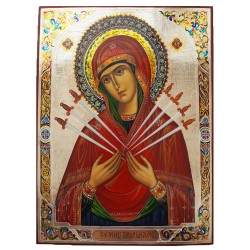
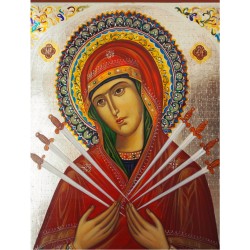
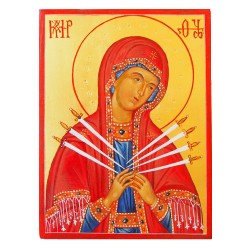
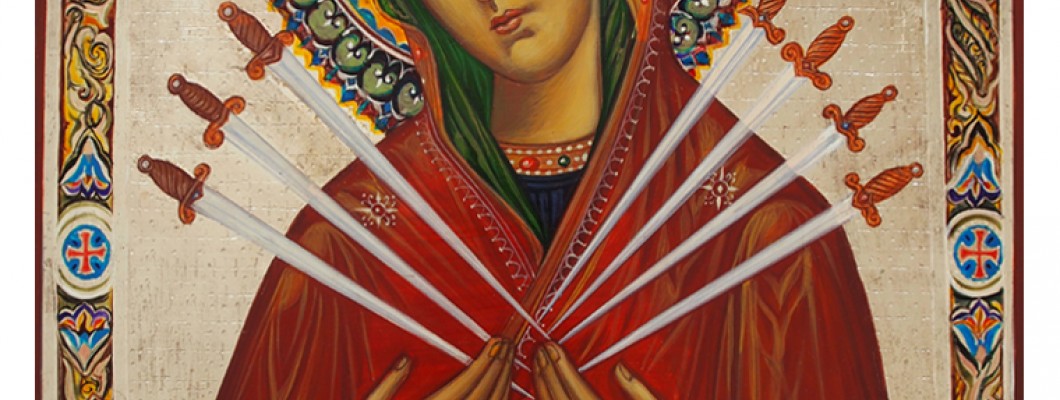
On it, the Mother of God is depicted alone, with her face turned towards the worshiper, and seven swords are pointed at her heart. Three of them are located on one side, four on the other. The image is connected with the Gospel story of the meeting of the elder Simeon the God-Receiver with the Infant Jesus in the Jerusalem Temple and with the words that he addressed to the Virgin Mary.
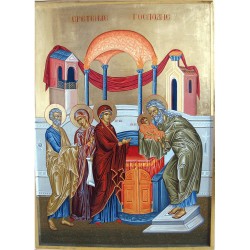
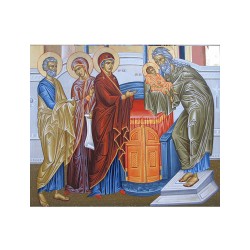
As the Evangelist Luke tells, the Holy Spirit revealed to the righteous elder Simeon that he would not die until he saw the promised Messiah. Simeon lived with this expectation and awaited the fulfillment of God's promise. When forty days after the birth of the Infant His parents took Him to the Jerusalem Temple, the elder went there by inspiration of God.
In the temple, Simeon took the Infant in his arms. From this gesture his nickname God-Receiver also comes. He received in his arms the Child, of whom the prophecies spoke and who had been awaited by generations. After this meeting, Simeon uttered the words known as the prayer of Saint Simeon the God-Receiver: “Now you are dismissing your servant, Master, according to your word, in peace…”
These words are part of the liturgical life of the Church. In them, Simeon spoke of the fulfilled promise and the salvation seen. Then he turned to the Most Holy Theotokos and uttered the prophecy: “Behold, this One lies for the fall and rising of many in Israel, and for a subject of controversy - and a sword will pierce your own soul - so that the thoughts of many hearts may be revealed”.
These words are connected with the future events of Christ’s earthly life and with the pain that His Mother will experience. In the Gospel account, they are uttered in the temple, at the meeting of Simeon with the Infant and His parents. Later they were associated with the images of the Holy Mother of God with a pierced heart.
The icon "Seven-Shot" presents the Most Holy Virgin frontally. Her face is calm, but filled with sorrow. The gaze is directed forward, without movement and without a gesture that would distract attention from the image. The swords are placed so as to form a visible composition around the heart. There are seven of them - three on one side and four on the other.
In Orthodox iconography, the number seven is found in various images and events. In this case, it is part of the name of the icon and the way in which Simeon's prophecy is presented. In the Holy Scriptures, the number seven usually means fullness, abundance, and in this case - the fullness and infinity of the sorrow that the Holy Mother of God experienced during her earthly life. The icon of the Seven Swords is distinguished from the similar image "Softening of Evil Hearts" by the location of the swords. In "Seven-shot" they are three on the right and four on the left, and in "Softening of Evil Hearts" they are three on both sides and one below.
Both images are associated with the same evangelical event and with the words of Simeon the God-Receiver. In different local traditions they received separate names and were venerated on different days. “Softening of Evil Hearts” originates from Southwestern Rus, while icon of the Seven Swords is associated with the North Russian tradition.
The “Seven-Shot” icon resided in the church of St. John the Theologian, located on the banks of the Toshna River, not far from Vologda. A legend has been preserved about it, connected with a peasant who had suffered from lameness for a long time. He sought help, but his condition did not change. Once, during a light nap, he heard a voice that ordered him to find an icon of the Most Holy Theotokos on the church bell tower and pray before it for healing.
The peasant went to the church and asked to be admitted to the bell tower. At first, he was ignored. He repeated his request, but again he was not allowed. Only on his third visit was he allowed to search for the icon.
In the bell tower it turned out that an icon covered in mud was used as a step on the ladder. The bell ringers stepped on it, not knowing what it was. After seeing it, the clergy took it out, washed it and cleaned it. A prayer service was served in front of it. According to legend, the peasant was then healed of his lameness.
Thus, the icon was removed from its place and placed for veneration. The legend of its discovery spread among the people, and it began to be associated with prayers for help in various sufferings.
The next famous event associated with the icon occurred in 1830. At that time, the Vologda province, like a large part of European Russia, was struck by a cholera epidemic. The disease spread rapidly and affected many settlements.
The Christian residents of Vologda turned to the church and organized a solemn procession. The Seven-Pointed Icon and other relics were included in it. The procession passed through the city, and people prayed for an end to the epidemic. According to legend, the cholera receded as suddenly as it had come.
In memory of this wonderful event, the townspeople ordered a copy of the Seven-Shot Icon. And about this copy began to be told stories of miraculous help. Thus, the veneration of the image spread beyond the place where the original icon was located.
According to tradition, the originally painted image is about five hundred years old. However, a copy has survived to this day, painted most likely in the 18th century. The history of the icon is connected with the church by the Toshna River, with the legend about the peasant and with the deliverance of Vologda from cholera in 1830.
The celebration of the Seven-Shot Icon is held on August 13 in the old style. In the church calendar, this day is dedicated to the veneration of the image. The icon "Softening of Evil Hearts" is celebrated on All Saints' Sunday. The different days of celebration are connected with individual local traditions and with the way in which the two images were distributed.
In the images of the “Seven-pointed” Virgin Mary, the Blessed Virgin Mary is usually depicted without the Child. This distinguishes her from many other icons of the Virgin Mary, in which Christ is depicted on her hands or next to her. Here, attention is focused on the face of the Mother of God and on the swords that pierce her heart.
The swords are depicted as weapons aimed at one place. The entire composition is focused on the Holy Virgin Mary. Her face is calm, and her eyes are open. In different copies, differences can be found in the colors, details of the clothes and the shape of the swords, but the main image remains the same.
The prophecy of the elder Simeon is quoted in the liturgical texts and is associated with the feast of the Presentation of the Lord. The event itself in the temple is described by the evangelist Luke. Simeon the God-Receiver, the prophetess Anna, the Infant Jesus, the Most Holy Virgin Mary and the righteous Joseph are represented there.
Simeon took the Infant in his arms and blessed him. Then he said: “Now you are letting your servant depart, Master, according to your word, in peace…”
The continuation of the prayer speaks of the salvation that God has prepared before the face of all nations. Then Simeon turned to Mary and spoke the words about the fall and rise of many in Israel, about the contradictions and about the sword that will pierce her soul.
These quotes have been preserved in the church memory and are associated with the iconographic image of the Holy Virgin Mary. The icons “Seven-pointed” and “Softening of Evil Hearts” represent a separate image of the Most Holy Virgin, associated with the prophecy uttered.
In various temples and private homes, the icon is placed in a place for prayer. Before it, believers turn with requests for health, for help in family difficulties, for peace in the home and for support in difficult times. Prayers are also addressed to her for deliverance from illnesses, fears and enmity.
The legend of the peasant who received healing is one of the reasons why the icon is associated with prayers for bodily health. The story of the cholera in Vologda is connected with the city-wide prayer and the liturgical procession. These events are part of the history of veneration of the image and have been passed down from generation to generation.
The history of the icon is connected with Russia, the Vologda region and the North Russian church tradition.
In some stories, the icon is called “Simeon’s Prophecy”. This name refers to the words spoken by Simeon the God-Receiver in the Jerusalem Temple. It shows the connection between the Gospel text and the image of the Holy Mother of God with swords.
The other name - “Softening of Evil Hearts”, is found in a similar iconographic image. It also depicts the Most Holy Mother of God with swords, but their arrangement is different. In the Orthodox iconographic tradition, the two images are perceived as close, but are venerated separately, on different holidays.
This information is part of the history of the image and the way it reached the believers. The icon continues to be present in temples, monasteries and private homes. Prayers, prayers and thanksgiving services are performed before it.
Thus, the Gospel story, church tradition and iconographic image come together in one common story. The icon has preserved the memory of prophecy, of veneration for the Holy Virgin Mary and of the prayers of people who have turned to it over the centuries.
Related Products